
BLOG
Italian Wine

Are you looking for the best Italian red grapes? The wonderful thing about Italian red grape varieties is that they are distinctly Italian. Plenty of winegrowers around the world have made attempts at growing Sangiovese, Nebbiolo and Barbera, but few have come even close to matching the results of these grapes’ native soils. As a rule, Italian grape varieties don’t care to leave Italy, and who could blame them? Completely at home in their places of origin or tradition, each Italian red grape has evolved and adapted in perfect harmony with their surroundings.

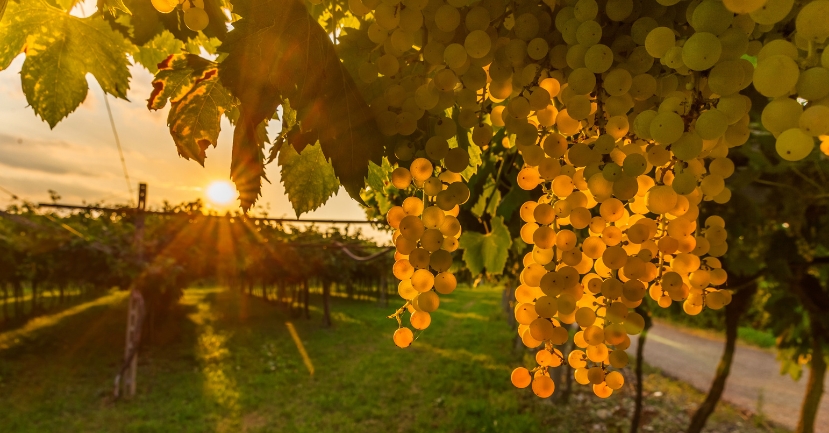
Glera is the principal grape of Prosecco sparkling wine. Originally the grape was known as Prosecco (more precisely Prosecco Tondo). The variety has an unclear origin and an even more complicated ampelographic history due to the fact that several distinct varieties have been called “Prosecco-something” in northeast Italy since the 18th century. The grape is late-ripening and prone to both fungal diseases and water stress. It is widely planted in the province of Treviso.

The grape varieties of Veneto Veneto’s grape varieties are almost equally divided between white and red. More than 60% of the cultivated varieties are native or Italian grapes. Among them, the indigenous Glera, Garganega and Corvina Veronese account for almost half of Veneto’s total plantings.

The Gallo Nero (Black Rooster) was the historic symbol of the League of Chianti and has become the symbol of the wines of Chianti Classico. The Black Rooster symbol is linked to a medieval legend that takes place during the time of open hostilities between Firenze and Siena for control of the Chianti territory.

Advances in the cellars coupled with better vineyard management and Friuli’s natural gift of a temperate climate, resulted in concentrated wines with an extra layer of richness. From the 1970s onward, Friuli gained commercial success and popularity for its white wines.

Friuli Grave DOC Friuli Grave was previously called Grave del Friuli but is often simply referred to as Grave. This is the largest DOC, both in terms of area under vine and in production. It accounts for more than one-third of Friuli’s total wine production.

This short article is a follow up to my webinar for WSG of 7th June, 2022. It is primarily a reference piece which aims to give more detailed information than the power point format allows. It includes full listings of the Rive sub-zones, terroir areas identified in studies of the Conegliano Valdobbiadene denomination and lists of producers currently bottling Rive wines.

The best way to make sense of Italian red wines is to simply start tasting them. Italy offers the perfect red wine for every occasion—from pizza on Monday to roast beef with the in-laws on Sunday.
Many of Italy's best red wines are labeled with the name of the wine appellation, often combined with the grape variety. If you've ever felt wholly overwhelmed while browsing an Italian wine section, knowing just a few key wine names will help keep your shopping trip focused and ensure that you have the perfect wine to drink at a moment's notice.

The Super-Whites of FriuliIn the late 1970s, the producer, Jermann, created Vintage Tunina, a complex blend of native and international white grapes that became iconic among Friuli’s superior white blends. Throughout the 1980s and 1990s, Jermann inspired several other Friuli producers, particularly in the DOCs of Collio and Friuli Colli Orientali.

I returned to Campania recently for the first time in three years and as with most Italian regions, discovered that not much had changed, at least as far as appearances are concerned. I did meet a few producers I hadn’t visited before, with one of them – Petilia – being a great new discovery for me. More on that below, but overall what impressed me most was the consistency of the wines, white and red.

Italian reds have become famous all over the world, characterized by their intense structures, rich perfumes and distinctive personalities, often derived from the peninsula’s characterful native grape varieties.

In a country famous for red wine, Italy’s white wines are often overlooked. Although the country has gone global with a range of crisp, well-priced and crowd-pleasing whites, there’s plenty of seriously impressive Italian white wine waiting to be discovered.
When you think of Italy’s vast array of wine grapes, which one comes to mind as the most difficult to study? Maybe Nebbiolo, for its seemingly endless site-specific details? Or Sangiovese, simply because there is so much of it, in so many different forms? I would posit that Trebbiano is perhaps the most perplexing. For one, Trebbiano grapes appear in vineyards across the Italian peninsula. In the case of Trebbiano Toscano and Trebbiano Romagnolo, they are among the most widely planted white wine grapes in Italy. The potential for variability is astounding.

The Romans arrived in Piedmont during the 2nd century BC, establishing colonies in Eporedia, Derthona, and Augusta Taurinorum (Ivrea, Tortona, and Turin, respectively). These territories were strategically important—their locality to the Alps helped the Romans control northerly invaders. As was customary, the Romans settled and built roads, aqueducts, amphitheatres, bridges, and established towns and cities. They also planted vines but were not the first to do so here...

Today, Veneto represents Italy’s most productive wine region and accounts for 25% of Italy’s total DOC/G wine production.

Grapes for Vin Santo Drying in the Vinsantaia
One of the most characteristic wines of Toscana is Vin Santo. This passito is an ancient and traditional specialty produced throughout the entire region. Its origin dates back to the Middle Ages, but the prototype for this style of wine can be traced back to the Greeks and the Romans.
Most Vin Santo is made from white grapes, typically Trebbiano Toscano and Malvasia Bianca Lunga. It can be made from just one of these grapes but is more commonly a blend of the two. Trebbiano provides acidity while Malvasia provides body, texture and perfume. A rare, pink Vin Santo called Vin Santo Occhio di Pernice (“partridge eye”) is made from red grapes, usually Sangiovese. Only a few producers make this pink version.

Learning Italian wine inside and out can be a thrilling experience, but it can also be confounding. The wrinkles in Italian wine law are numerous, and staying on top of the latest modifications to DOC and DOCG regulations can feel as time consuming as the slow train from Naples to Sorrento.
Fortunately, we have Maurizio Broggi on our side. As Education Director for the Italian Wine Scholar® program, he stays in close contact with Italy’s innumerable consorzi to learn about trends in the vineyards and wineries, as well as changes to their regulations — all so he can keep our education materials up-to-date.

Collio (or Collio Goriziano) DOC Collio’s vineyards date back to pre-Roman times; they were of renown then and are held in high esteem now. Their impressive whites are considered the finest in Friuli and are among the finest in Italy.

The wines of Valpolicella dance across the tongue with the same lift and loveliness as the name itself. Ideal with humble pastas as well as lighter red meats and game birds, it is well-suited to the table. As the more modest bottling of the Valpolicella region, it is largely (and unfairly) overlooked among Italian reds these days.
Valpolicella is the so-called “everyday” red wine of the eponymous production zone that is situated just north of the city of Verona, and extends west and east of the city. Other reds here include the iconic Amarone della Valpolicella as well as Ripasso, a wine made via a method of refermentation and remaceration, in which a Valpolicella is “repassed” over the skins of grapes used for Amarone.